If a regular road car crashes into a concrete wall at 200 km/h, nothing will be left of the car, and as for the driver... well, you get the picture. In Formula 1, drivers regularly survive crashes at speeds near 300 km/h, walking away with nothing more than a scare and a few bruises. What's the magic? No magic—just pure physics, carbon fiber, and a ton of sweat poured in by safety engineers. Let's break down how the "bulletproof" capsule is designed, inside which drivers play with death every single weekend.
1. Carbon Fiber: Why Carbon?
All of modern F1 relies on Carbon Fiber Reinforced Polymer (CFRP). It is a super-material that combines the two main qualities for motorsport: it is ridiculously lightweight and insanely strong.
How is it made?
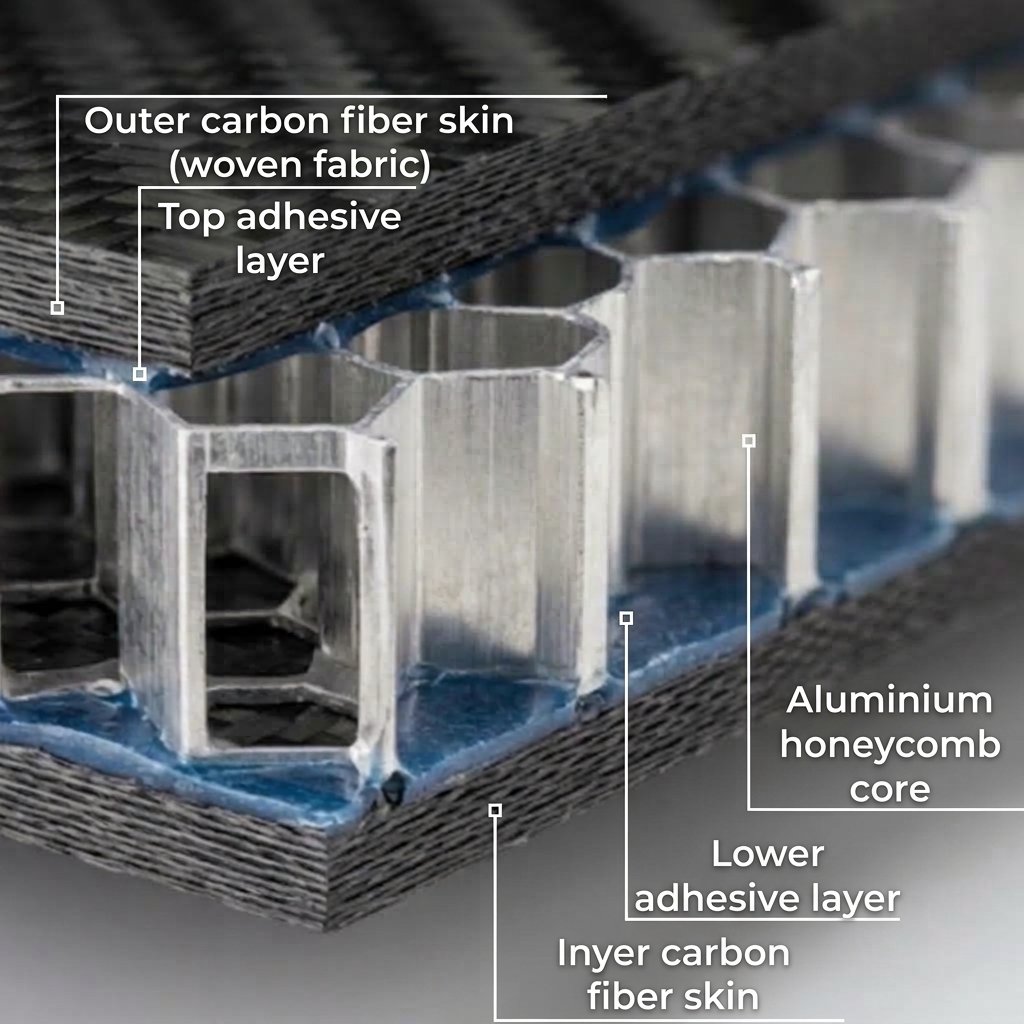
The monocoque is not cast from metal or welded from tubes. It is sewn and baked like an expensive layer cake:
1. Fabric made of paper-thin carbon threads is taken (each thread is dozens of times thinner than a human hair).
2. This fabric is impregnated with a special resin (prepreg).
3. Craftsmen manually lay down dozens of layers of this fabric into a special mold, strictly adhering to the direction of the fibers.
4. Inside the layers, a honeycomb structure made of aluminum or aramid (Nomex) is "baked in"—this creates a "sandwich" effect that increases rigidity multi-fold without adding weight.
5. The entire construction is sent to an autoclave—a huge high-pressure oven where the resin polymerizes at high temperatures.
The result is a monolithic part—the monocoque, which weighs only about 35–45 kg, but is virtually impossible to bend or break using human force.
2. Survival Cell
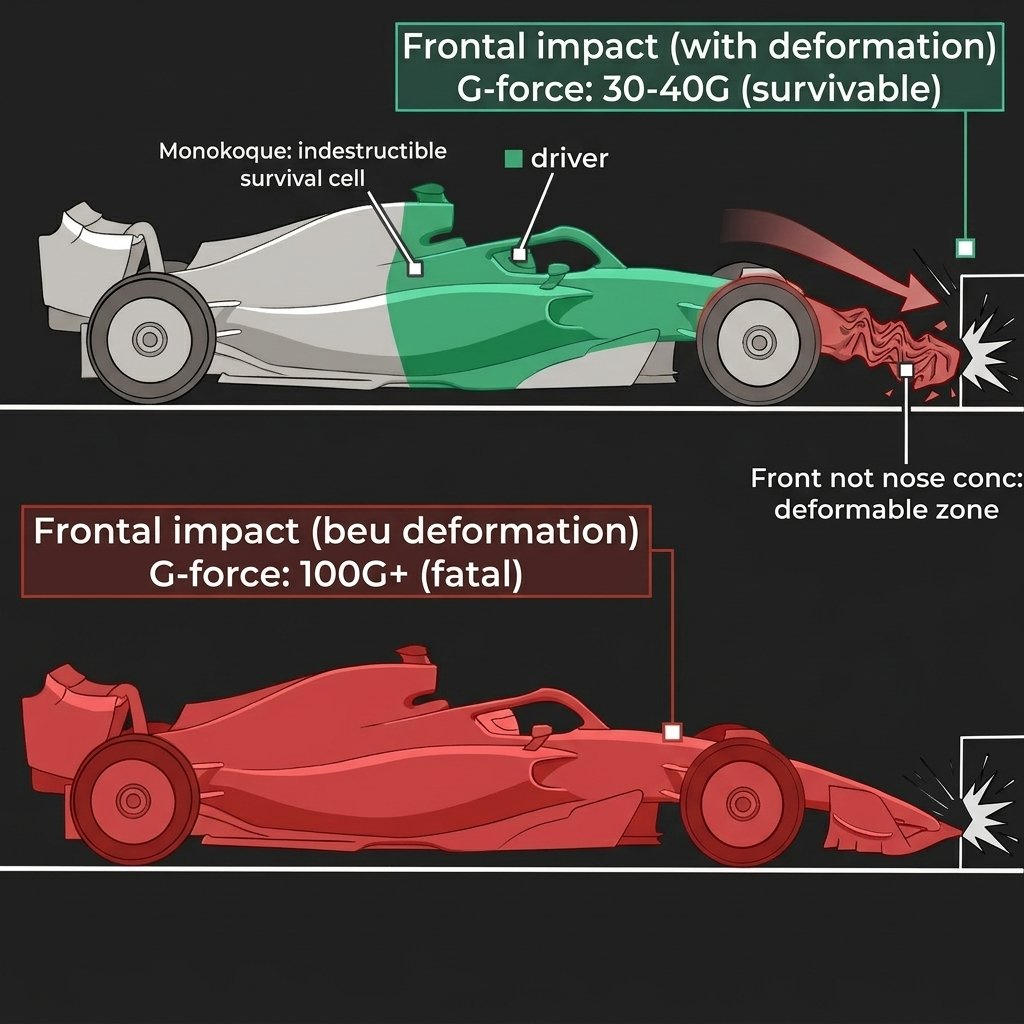
The monocoque is a rigid, non-deformable capsule. The main rule of engineers: everything outside the monocoque must break, but the monocoque itself must remain intact at all costs.
Inside the survival cell are the driver, their seat, the fuel tank, and the pedal box. It is designed to withstand colossal loads:
• Compression: From above and from the side, the capsule can withstand point loads of dozens of tons.
• Penetration: Kevlar (the very same material used for bulletproof vests) is added to the carbon layers so that sharp debris from suspension or other cars during a crash cannot pierce the wall and injure the driver.
3. Crumple Zones: The Art of Impact Damping
Why not make the entire car out of the same rigid carbon as the monocoque? Because then, during a crash, the G-force would kill the driver. If a car moving at 250 km/h stops instantly upon hitting a wall, human internal organs simply cannot survive the deceleration. The kinetic energy of the impact must be dissipated.
To achieve this, special "sacrificial" structures—Crash Structures—are installed at the front and rear of the monocoque:
• Front Crash Box: A carbon-composite cone beneath the nose cone. In a head-on collision, it doesn't bend—it disintegrates into dust and fine fragments. Disintegrating this carbon absorbs a massive portion of the impact energy.
• Rear crash box: Attached to the gearbox, it takes the brunt of the impact if someone rear-ends the car.
• Rear crash box: Attached to the gearbox, it takes the brunt of the impact if someone rear-ends the car.
It looks terrifying when thousands of tiny splinters fly off an F1 car during a crash, but for engineers, it is a success: the more components disintegrate, the less energy reaches the driver's body.
4. Halo System: The Titanium Guardian Angel
In 2018, the FIA mandated the Halo system for all teams. Initially, fans and drivers alike complained: "Ew, what are these thongs doing on the wheels? It ruins the car and destroys the DNA of Formula 1!" Yet within a couple of years, the titanium "wishbone" silenced every single skeptic.
What is it made of?
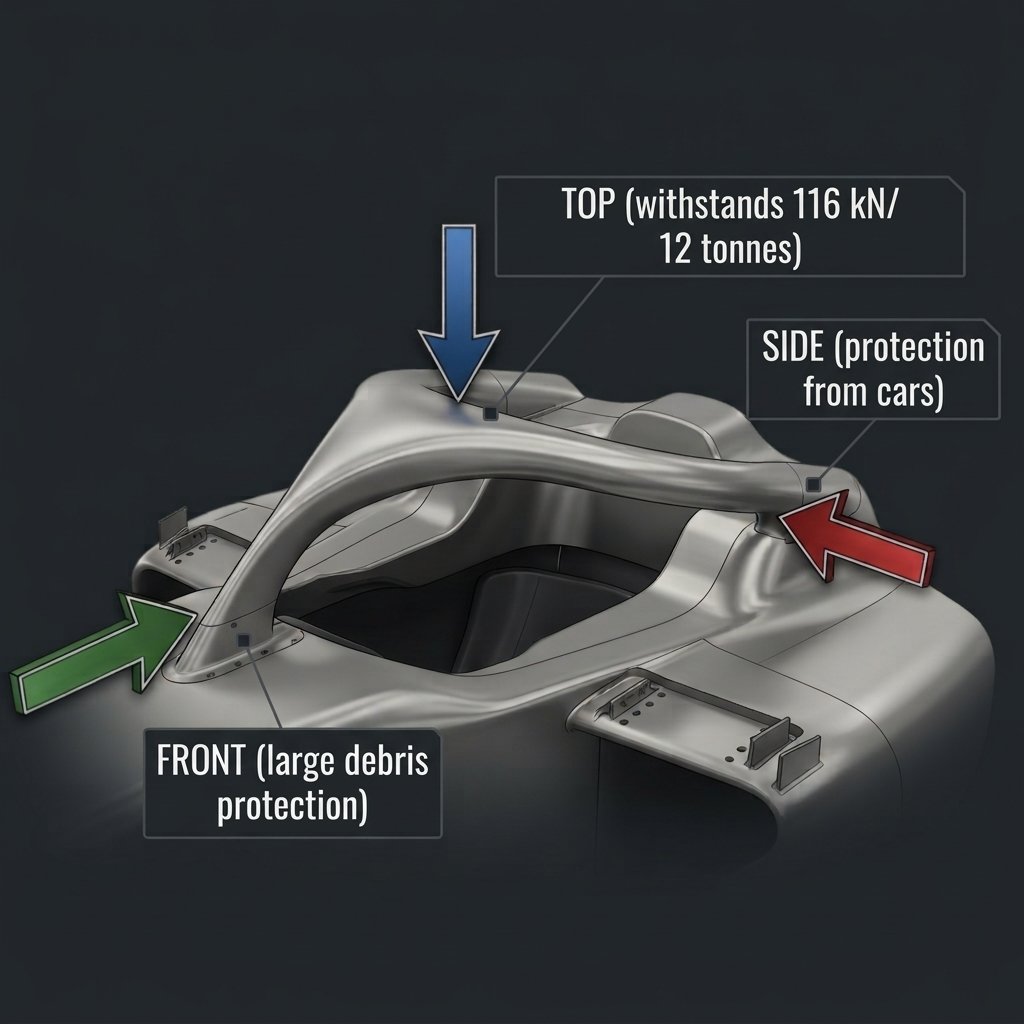
The Halo isn't made of carbon fiber, but rather a grade 5 titanium alloy. It weighs only about 9 kg, yet it can withstand a load of 12 tons (equivalent to placing a double-decker bus on top) or an impact from a flying wheel traveling at 225 km/h.
How does it save lives?
• Charles Leclerc (Spa, 2018): Fernando Alonso's car literally flew over Leclerc's head. The Halo took a deep dent from the wheel, while Charles escaped without a single scratch.
• Romain Grosjean (Bahrain, 2020): At 240 km/h, the car pierced a steel guardrail completely, cutting right through it. Without the Halo, the guardrail would have decapitated the driver. The titanium hoop pried the steel sheets of the barrier apart and created a survival "air pocket."
• Max Verstappen and Lewis Hamilton (Monza, 2021): Max's car landed its rear wheel right on Hamilton's cockpit. The Red Bull's floor and wheel were pressing directly toward Lewis's head, but the Halo absorbed the full weight of the car.
Summary: Formula 1 Safety Anatomy
1. Monocoque: A rigid armored capsule made of carbon fiber and Kevlar that must not deform under any circumstances.
2. Crash boxes: Fragile carbon structures at the front and rear that destroy themselves during a crash to absorb kinetic energy.
3. Halo: A titanium cage above the driver's head that shields them from flying cars, wheels, and guardrails.
Remember: A modern F1 car is engineered so that in a nightmare crash, it will destroy itself down to the last screw to keep the human inside completely intact.