In Formula 1, tyres are not just "round black rubber". They are a highly complex chemical cocktail of synthetic and natural rubbers, resins, and cords. Most importantly, Pirelli deliberately engineer tyres with limited life to ensure exciting racing, pit stops, and tactical battles.
Let’s break down how this black magic works.
1. Compound Range: C1 to C5
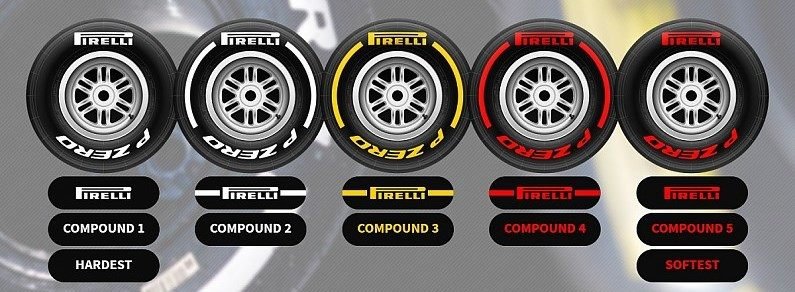
Every season, Pirelli homolgate 5–6 slick compounds (treadless tyres) — from C1 (hardest) to C5/C6 (softest). The letter "C" stands for Compound.
For each race weekend, Pirelli select three compounds from this range and identify them by color:
• Soft (Red): The softest of the chosen trio. Delivers maximum grip, but wears out quickly.
• Medium (Yellow): The balance between speed and durability.
• Hard (White): The hardest. Warms up slower and provides less grip, but lasts almost indefinitely.
How it works in practice:
At the Monaco GP (smooth asphalt and low loads), Pirelli bring the softest tyres: C3 = Hard, C4 = Medium, C5 = Soft.
At Silverstone (long high-speed corners and extreme loads), they bring the hardest selection: C1 = Hard, C2 = Medium, C3 = Soft.
2. Pirelli Wet Tyres: Green and Blue Hell
The main goal of wet tyres is to disperse water from the contact patch. If a water film forms between the rubber and the asphalt, aquaplaning occurs: the car loses all traction, stops responding to steering or brakes, and turns into an uncontrollable 800-kilogram torpedo.
To prevent this, wet tyres feature deep tread grooves.
1. Intermediate Tyres ("Inters")
• Marking: Green stripe.
• When used: Damp track, starting or clearing rain, or when a dry racing line begins to emerge ("drying track").
• Water evacuation: Displaces up to 30 liters of water per second from a single wheel at 300 km/h.
• Main secret: The most versatile and driver-favorite tyre in tricky conditions. It doesn't have the deepest tread, so it holds grip exceptionally well on both wet and semi-dry asphalt.
Tricky feature of Inters: If the track dries up quickly and the driver stays on intermediates, the tread grooves start overheating rapidly due to friction against dry asphalt. The rubber burns up in just a couple of laps. Drivers have to steer off the dry line onto wet kerbs/edges to cool the tyres with water.
2. Full Wet Tyres ("Full Wets")
• Marking: Blue stripe.
• When used: Heavy downpours, standing water, and deep puddles on track.
• Water evacuation: A real monster pump! Displaces up to 85 liters of water per second from a single wheel at top speed.
• Key feature: Deepest tread and higher profile (the blue tyre diameter is 10 mm larger than a slick). This is specifically designed to slightly raise the car's ride height and prevent the Venturi tunnels under the floor from scooping up water.
Main paradox of modern Full Wets: Blue tyres clear water so effectively that they spray a massive cloud of water mist behind the car. As a result, the tyres handle the water fine, but drivers are racing blind — visibility is zero. That is why race control often red-flags the session: not because the tyres lack grip, but because drivers cannot see more than 5 meters ahead.
3. Working Range
An F1 tyre doesn't grip the asphalt purely due to surface roughness. At the correct rubber temperature, micro-welding occurs: chemical bonds in the tyre's surface layer literally fuse with the asphalt's texture on a molecular level.Every compound has its own thermal window (typically around 90°C–120°C):
• Tyre too cold (< 80°C): Rubber is hard, like plastic. The car slides, the driver cannot brake properly, and the rubber starts graining/tearing.
• In the sweet spot (~ 100°C): Peak grip. The car handles like it's on rails.
• Tyre overheated (> 120°C): The outer layer boils, the rubber "greases over", grip drops off a cliff, and thermal degradation begins.
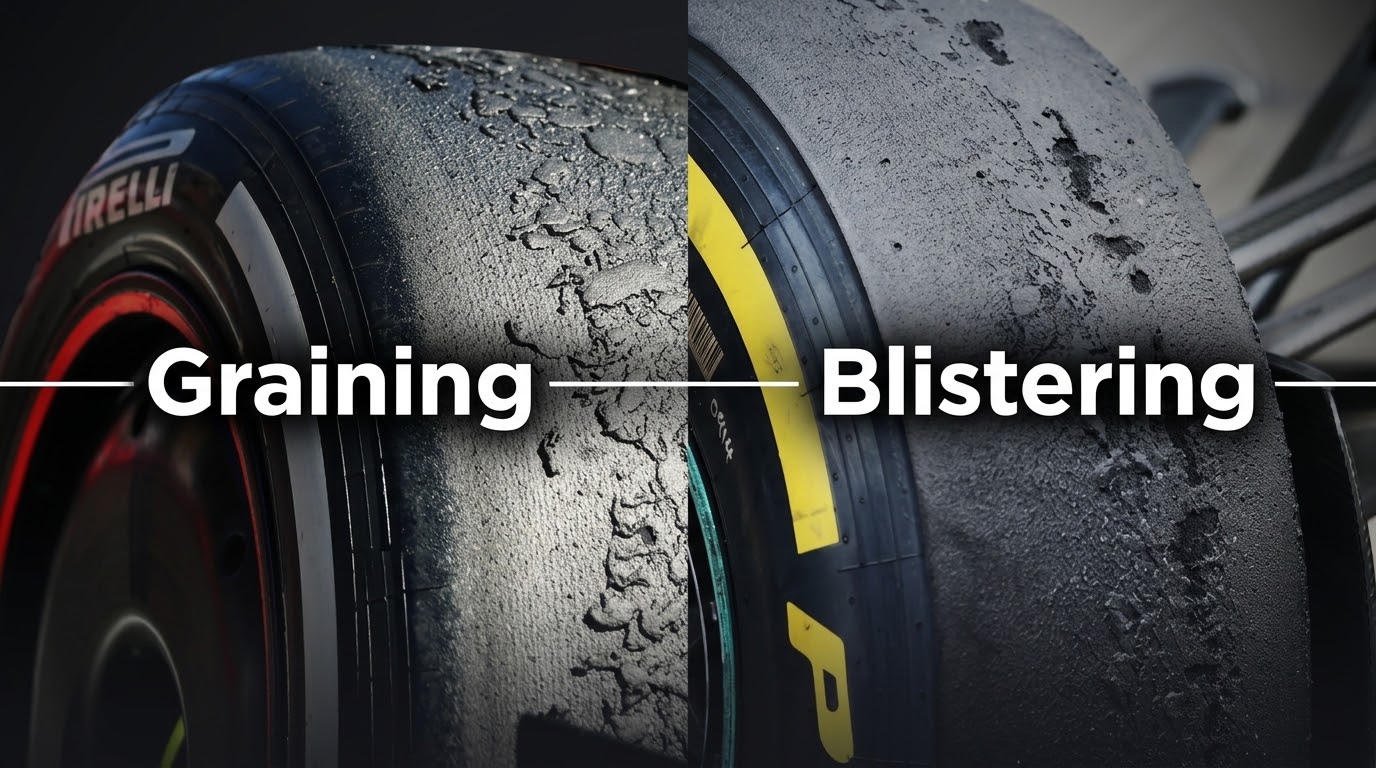
4. Two Main Tyre Diseases: Graining and Blistering
These are two different types of tyre destruction. They are often confused, but they happen for completely opposite reasons.
1. Graining — The "cold tyre" disease
• How it happens: If the surface layer heats up quickly while the inner carcass remains cold and stiff, shear forces rip off chunks of the surface rubber. They roll up into small debris ("marbles") and stick back onto the tread.
• Result: Instead of smooth rubber-to-asphalt contact, the car rides on rubber marbles. Grip is lost, and severe vibration occurs.
• How to fix: The driver must manage the pace carefully until the inner carcass warms up and the marbles gradually rub off against the track (the clean-up phase).
2. Blistering — The "overheating" disease
• How it happens: Deep inside the tyre (near the carcass), temperatures exceed safe limits. Gases and elastomers boil, forming air bubbles. As the gas expands, it literally explodes the top layer of rubber from the inside out, ripping away entire chunks of tread.
• Result: Deep craters and holes from on the tyre surface. A massive amount of grip is lost instantly, and the tyre is ruined.
5. Mechanical vs. Thermal Degradation
Drivers often complain on the radio: "My tyres are dead". But tyres die in different ways:
1. Mechanical Wear: Rubber physically wears off on the asphalt, like an eraser on paper. The tread layer gets thinner. Nothing can be done about this — the tyre simply reaches the end of its useful lifespan.
2. Thermal Degradation: The tread is still thick enough, but constant overheating alters the chemical composition of the compound ("glazing"). The tyre loses elasticity and stops keying into the asphalt, even if it looks like new.
Summary: Key Takeaways on F1 Tyres
1. C1–C5: The higher the number, the softer the compound, the more grip it gives, but the shorter its lifespan.
2. Working Window (90–120°C): A driver's main goal is to keep tyres in this range through braking and line choice.
3. Graining: Rubber marbles on the surface caused by a cold inner carcass.
4. Blistering: Holes and craters on the tyre caused by internal overheating.