In Formula 1, there is a golden rule: the heavier the car, the slower it is. Every extra 10 kg of mass costs about 0.3 seconds per lap. In a sport where pole position is decided by thousandths of a second, 0.3 seconds is not just a gap, it is an abyss as wide as eternity.
But what do you do if the regulations explicitly state: "The car cannot weigh less than a certain figure"? That is where the game with ballast and weight distribution begins.
1. Minimum Weight Limit: Why Is It Needed?
Under the current regulations, the minimum weight of the car with an empty fuel tank, but including the driver, is 798 kg.
Why introduce a lower limit at all?
1. Safety: Without a limit, teams would start saving weight on carbon thickness, suspension strength, and protective elements.
2. Financial barrier: Creating ultra-light exotic alloys costs astronomical amounts of money.
3. Protection for taller drivers: Previously, taller drivers (like Nico Hülkenberg or Mark Webber) were in a terrible position: they had to severely starve themselves and lose muscle mass just to avoid losing out to shorter, lighter drivers (like Felipe Massa). Now the driver's weight, including gear and seat, is fixed at a minimum of 80 kg. If a driver weighs 68 kg, 12 kg of ballast is simply bolted under their seat. Developing anorexia for speed is no longer an option!
2. The Ideal Scenario: Building Underweight
The dream of every F1 chief designer is to build a car that, together with the engine and driver, weighs, say, 770 kg (which is 28 kg under the regulation limit).
Why make the car too light if it won't pass the FIA technical inspection anyway?
Because engineers can make up for the missing 28 kg using ballast!
What's the catch with ballast?
If a car component is heavy, its weight stays right where it's installed (for example, a heavy engine element 30 cm off the ground). But if you have "free" ballast, you have the right to bolt it anywhere on the car:
• Lower it as close to the asphalt as possible — this lowers the center of gravity (CoG) and reduces body roll in corners.
• Shift it forward or backward — to fine-tune the balance between the front and rear axles for a specific track and tire compound.
Tungsten (wolfram) is the engineers' favorite material for ballast. It is incredibly dense (nearly 2.5 times denser than steel) and heavy, so a plate the size of a chocolate bar can weigh several kilograms and easily hide at the very bottom of the monocoque.
3. Engineer's Nightmare: Overweight
When regulations change (as happened in 2022), almost all teams arrived at testing with massive excess weight. Red Bull and Mercedes cars were 10–15 kg above the limit.
Why is this a catastrophe?
1. Loss of raw speed: The car struggles to accelerate and brakes later.
2. Tire destruction: The heavier the car, the more it slides in corners, overheating and wearing down the rubber.
3. Zero setup flexibility: You have no free ballast. You can't tune the weight distribution — the car drives however its heavy components dictate.
To shed weight, teams have to go to extremes: they start... scraping off paint! You've probably noticed that modern F1 cars are half black. That isn't a design choice, that's bare carbon fiber. Ditching paint and clear coat saves a team around 300–500 grams!
4. Mass Distribution and Handling Impact
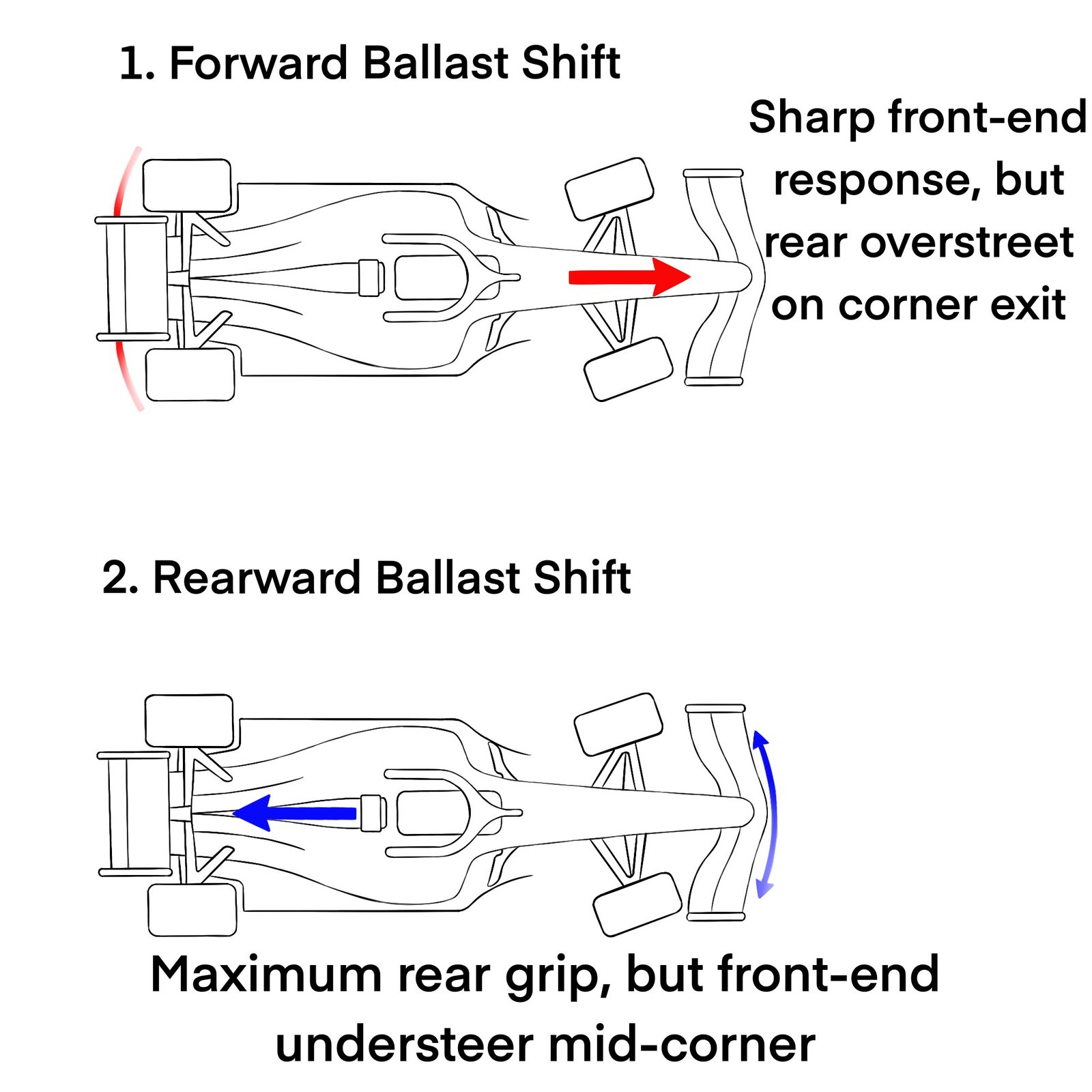
FIA regulations strictly govern the weight distribution range: typically, the front axle must account for about 45.5–46.5% of the mass, and the rear axle 53.5–54.5%. Even a tiny shift in the center of mass using ballast changes the car's behavior:
Weight shifted FORWARD:B
• Advantage: Front wheels press harder into the road, the car responds instantly to steering input (sharp front end).
• Disadvantage: The rear axle is unloaded.
Weight shifted BACKWARD:
• Advantage: Excellent traction on acceleration (rear wheels are pressed into the asphalt).
• Минус: Disadvantage: Front end lacks weight. In corners, the car stubbornly pushes straight ahead, refusing to turn (understeer).
Summary: The Rule of Kilograms in F1
1. 798 kg is the sacred number. Lower is forbidden, higher is slow.
2. Building underweight is every engineer's primary goal to gain "free" ballast.
3. Tungsten ballast is placed at the very bottom to lower the center of gravity as much as possible and balance tire loads.
4. Every single gram matters — down to stripping the paint off the chassis.