If you look at a Formula 1 car from the side, it might look like a hyper-fast go-kart with a bunch of wings and sponsor decals. But strip away the carbon-fiber bodywork, and you are looking at a wild engineering puzzle where every single millimeter counts.
F1 car designers do not just fight for speed; they fight for packaging. The challenge is to cram a human, a 1000-horsepower hybrid power unit, a fuel tank, a gearbox, and complex electronics into a tight carbon-fiber cocoon so that the machine does not roll over in corners, does not overheat, and outpaces everyone else. Let us break down how this Tetris on wheels is built.
1. Monocoque: Safety Tub and the Driver's Office
At the core of the entire build is the monocoque, also known as the cockpit or survival cell. It is an ultra-strong tub made of carbon fiber and an aluminum or Kevlar honeycomb core. It acts simultaneously as a rigid chassis to which everything else is attached and as a survival capsule.
How Does the Driver Sit?
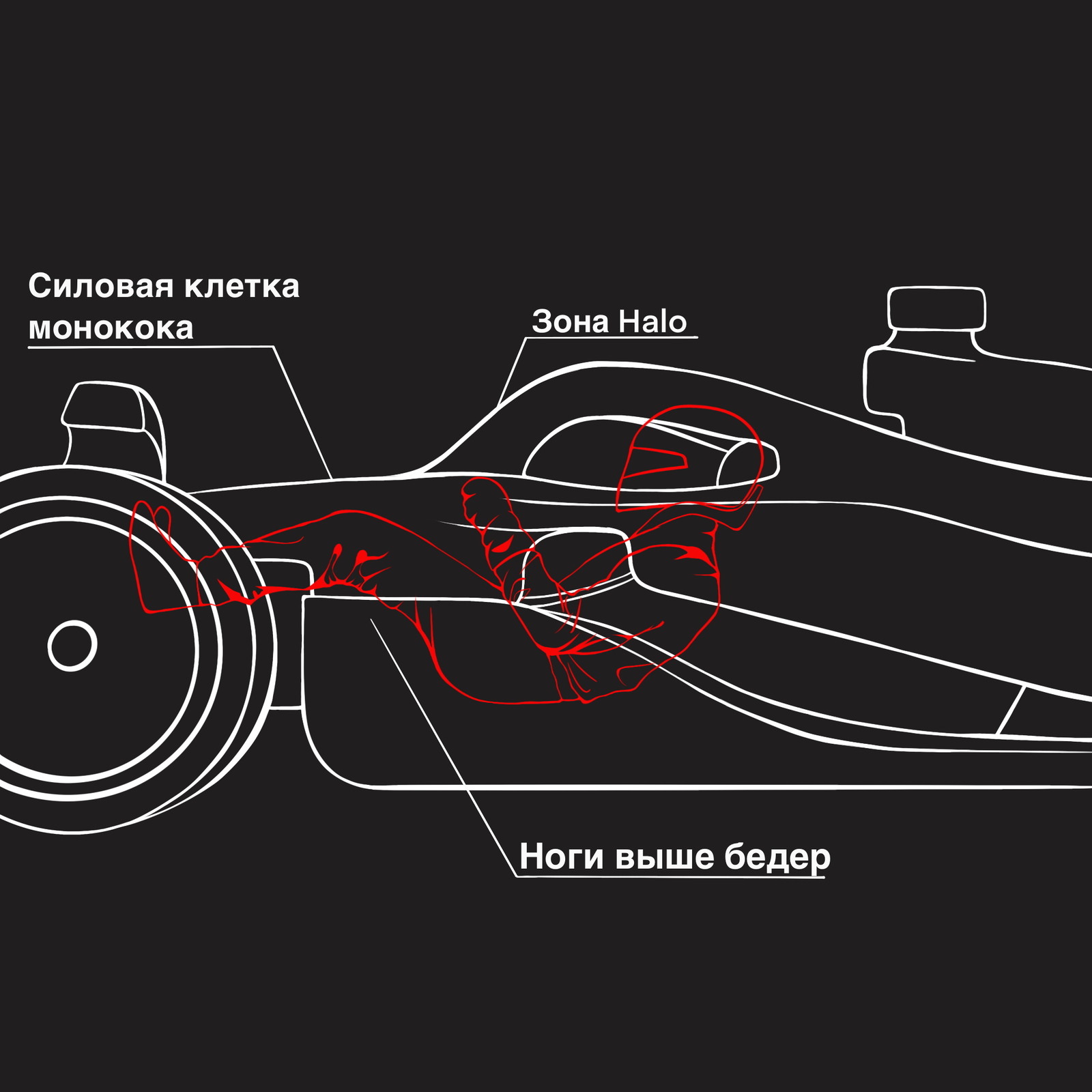
Forget about comfortable seats with adjustable backrests. An F1 driver is almost lying down.
• Position: Legs are raised high up (roughly at chest level and above the front wheels), with the back reclined at an angle of about 30 to 40 degrees. This is done to minimize frontal aerodynamic drag as much as possible and keep the center of gravity as low to the ground as possible.
• Seat Fitting: The seat is custom-molded for each driver. Drivers are literally forced to sit in liquid foam, which hardens and mirrors every contour of their body. There are no soft cushions in a seat like this; every bump on the kerb is transmitted directly into the spine.
• Halo System: The titanium wishbone above the driver's head. It can withstand the weight of two double-decker London buses (around 12 tonnes) and protects the driver's head from flying wheels and debris.
2. Fuel Tank: Between the Driver's Back and Hell
Located directly behind the driver's back, but ahead of the engine, sits the fuel tank. Refueling has been banned in F1 since 2010, so around 110 kg of fuel is pumped into it before the start of the race.
• It is not a metal canister: The tank is made of a flexible Kevlar-rubber bladder (an impact-resistant soft fuel cell) to prevent it from tearing and causing a firestorm during a crash.
• Internal Baffles: Inside the tank is a complex system of baffles and one-way valves. Without them, braking from 300 km/h would send all the fuel sloshing forward, drastically shifting the car's balance and starving the fuel pump.
3. Power Unit and Gearbox: The Heart and Tail
Behind the fuel tank begins the domain of mechanical components and hybrid technology:
1. ICE (Internal Combustion Engine): A turbocharged V6 engine with a displacement of just 1.6 liters. It is bolted directly to the monocoque and acts as a stress-bearing chassis element to which the rear section of the car is attached.
2. Hybrid Modules (MGU-K and MGU-H): Electric motor-generators and the turbocharger are tightly packaged around the cylinder block.
3. Battery (Energy Store): Positioned as low as possible — usually directly under the fuel tank or beneath the engine — to lower the center of gravity.
4. Gearbox: The eight-speed sequential gearbox is located behind the engine. Its casing is often made of titanium or carbon fiber, and the rear suspension mounts directly to it.
All these components bolt together to form a single rigid backbone: Monocoque -> Fuel Tank -> Engine -> Gearbox. An F1 car does not have a traditional spaceframe to mount everything on; the engine and gearbox themselves function as structural members of the chassis!
4. Почему центровка и развесовка — это всё?
Можно построить мотор на 1500 сил и нарисовать идеальные крылья, но если неправильно распределить вес, болид превратится в неуправляемое ведро.
Что такое центр тяжести и почему он должен быть «в полу»?
Чем ниже центр тяжести (Center of Gravity, CoG), тем меньше болид кренится в поворотах и «кивает» при торможении. Именно поэтому инженеры пытаются опустить тяжелые детали (аккумуляторы, мотор, самого пилота) как можно ближе к асфальту.
Развесовка по осям (Static Weight Distribution)
Регламент FIA строго задает минимальный вес болида (798 кг вместе с пилотом) и пропорции распределения массы между передней и задней осью (примерно 45–46% на перед и 54–55% на зад).
• Слишком много веса спереди: Передние шины перегружаются и быстро сгорают, зад сносит при разгоне.
• Слишком много веса сзади: Перед сносит в поворотах (недостаточная поворачиваемость), машина плохо реагирует на руль.
Проблема расхода топлива в гонке
На старте болид весит 798 кг + 110 кг топлива = 908 кг. К концу гонки бак пустеет, и машина становится на 110 кг легче!Так как бак расположен ровно между пилотом и мотором (близко к центру масс), по мере сгорания бензина общий вес уменьшается, но процентный баланс между передней и задней осью практически не смещается. Это инженерный шедевр: характеристика управляемости болида остается стабильной от 1-го до 57-го круга.
Резюме: Анатомическая карта болида F1
1. Спереди: Ноги пилота, рулевое управление и элементы передней подвески.
2. В центре: Сам пилот в карбоновом коконе (монококе).
3. За спиной пилота: Эластичный бензобак и батареи.
4. За баком: Двигатель V6, турбина и гибридные электромоторы.
5. Сзади: Коробка передач, задняя подвеска и выхлопная система.
Каждый компонент в этой цепочке подогнан с точностью до долей миллиметра. В следующих статьях мы разберем, как вся эта масса удерживается на трассе с помощью подвески, балласта и безумного прижима аэродинамики!